If you're a federal contractor in 2026, the RMF ATO process isn't a compliance side project. It's a revenue gate. No ATO, no production system, no contract performance.
I've shepherded Moderate-impact ATO packages in DoD environments from a blank baseline all the way to a signed authorization letter. I've also inherited broken packages that took months to untangle because of avoidable mistakes. The pattern is always the same: authorization delays rarely come from exotic zero-day threats or sophisticated adversary models. They come from sloppy boundary definitions, weak SSP narratives, misunderstood inheritance, eMASS workflow errors, and remediation timelines nobody believes.
This guide walks through each RMF step in contractor language — what the NIST 800-53 compliance process actually looks like on the ground, what your ATO documentation requirements really are, where contractors consistently trip up, how long authorization actually takes, and how to get through it without losing credibility with your Authorizing Official.
This isn't academic RMF. This is field execution.
What the RMF ATO Process Really Is
At its core, the RMF ATO process is risk validation. The government is asking one simple question: Can we trust this system to operate within acceptable risk?
To answer that, you need to prove five things:
- You know your system boundary and data flows.
- You've selected the right controls for the system's impact level.
- Those controls are implemented correctly.
- You've verified they work as expected.
- You have processes to keep them working over time.
That's the entire authorization philosophy.
Most contractor systems handling Controlled Unclassified Information land at a Moderate impact level under the NIST 800-53 compliance process. That baseline includes hundreds of controls and enhancements spanning access control, audit logging, incident handling, configuration management, contingency planning, and more.
But here's the thing — RMF doesn't care about how many controls you can list. It cares whether your implementation story matches operational reality.
The 7 RMF Steps Explained for Federal Contractors
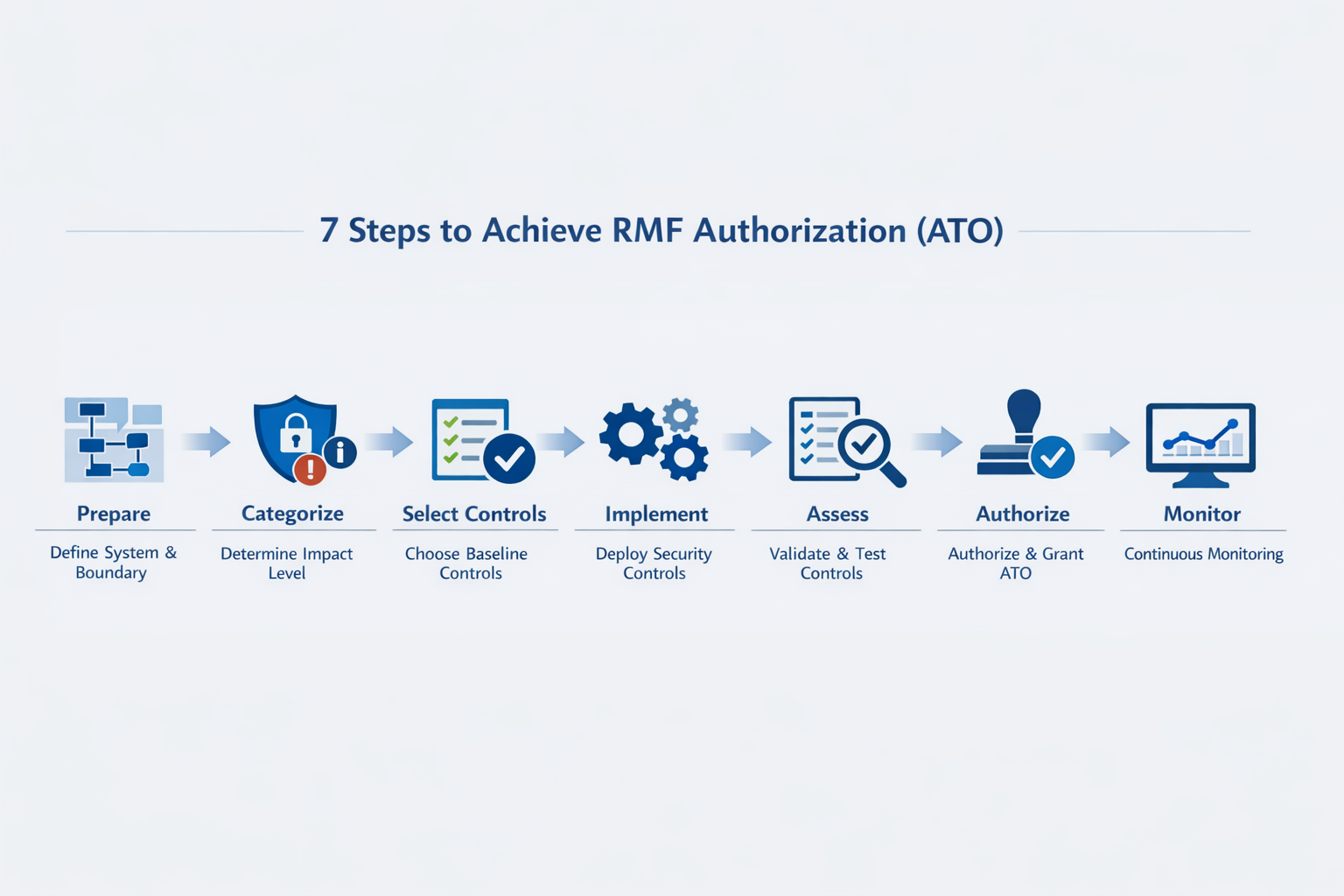
Step 1: Prepare
Preparation sets the trajectory of the entire authorization. This is where you establish the system boundary, identify the system owner and key stakeholders (ISSM, ISSO), define the mission function, classify the data the system processes, and lay out your authorization strategy.
Contractors consistently underestimate this step. They treat it as a kickoff checklist when it's actually a boundary engineering exercise. Scope control happens here. Draw the boundary too wide and you inherit unnecessary control overhead. Draw it too narrow and assessors will expand it later, forcing rework across the entire package.
Good preparation means well-defined trust boundaries, logical and physical architecture diagrams that actually reflect the environment, and accurate data flow representations showing external connections and authentication paths.
If you get this step wrong, every artifact downstream becomes unstable. I've seen entire SSPs rewritten because the original boundary definition was vague or inaccurate. Preparation isn't administrative — it's architectural.
Step 2: Categorize
Categorization determines the impact level based on confidentiality, integrity, and availability. For most DoD contractor systems handling CUI, the answer is Moderate.
That designation drives the control volume, assessment rigor, and documentation expectations for the rest of the process. Many contractors try to argue down the impact ratings to reduce the control burden — this backfires. If your justification is thin or doesn't match what the system actually does, reviewers will question your entire risk posture.
The NIST 800-53 compliance process is built on this categorization. It determines tailoring decisions, testing scope, and continuous monitoring expectations. Re-categorizing mid-process can cost you months.
Get it right the first time.
Step 3: Select Controls
Control selection turns your categorization into action. You start with the baseline and tailor it based on system characteristics, overlays, and mission requirements. You determine which controls and enhancements apply, and which can be inherited from hosting providers or enterprise services.
Inheritance is where contractor packages consistently fall apart. If you're running in a government cloud enclave or on FedRAMP-authorized infrastructure, you can inherit certain controls — but the mapping has to be explicit. Your responsibility matrices need to clearly delineate what the provider covers and what your team owns.
Assuming "the cloud handles it" without documenting exactly what that means will generate unnecessary testing and findings during assessment.
Control selection is strategic. Smart tailoring prevents scope creep and assessment churn.
Step 4: Implement Controls
This is where engineering discipline meets compliance precision. Access control enforcement has to reflect role-based policies. Audit requirements have to match logging configurations. Patch management needs defined schedules. Incident response plans need to be testable and documented. Configuration baselines have to be versioned and enforced.
The biggest failure point at this stage is sequencing. Teams deploy security tools first and write the documentation months later. When implementation isn't documented in real time, gaps open between what the narratives say and what the system actually does.
Assessors catch those inconsistencies fast.
Implementation is the stage that determines whether your assessment becomes a validation exercise or a discovery mission. If you want to know how to get an ATO efficiently, this is the step to get right.
Step 5: Assess Controls
Assessment is external validation. Assessors review your SSP, examine diagrams, interview staff, review scan results, sample configurations, and verify evidence. In DoD environments, eMASS needs to show control status, artifacts, and POA&M entries that align with the assessment results.
Administrative maturity matters as much as technical maturity. Incorrect control status entries, missing artifact attachments, or inconsistent POA&M milestones can stall authorization even when there are no real technical findings.
Teams that run internal mock assessments before the formal engagement consistently reduce their remediation cycles. That kind of preparation typically shaves weeks off the evaluation timeline.
Assessment is about risk transparency, not perfection. Zero findings are rare. What creates AO confidence is controlled, well-documented remediation.
Step 6: Authorize
The Authorizing Official reviews the SSP, Security Assessment Report, POA&M, and risk summary. The decision is a full ATO, Interim ATO, or denial.
In 2026, AOs are putting more weight on continuous monitoring maturity. Even technically strong systems can hit delays if the monitoring processes look weak or remediation timelines seem unrealistic.
Authorization isn't a stamp of perfection. It's an acceptance of risk.
Step 7: Monitor
Monitoring sustains the authorization. You need to maintain vulnerability remediation cycles, update SSP documentation when changes occur, conduct periodic reassessments, document configuration updates, and track POA&M progress.
Continuous monitoring is not a reporting obligation — it's operational governance. Organizations that treat it as an afterthought tend to struggle during reauthorization or contract option renewals.
ATO isn't the finish line. It's the start of sustained accountability.
ATO Documentation Requirements for Federal Contractors
A Moderate-impact documentation package typically includes:
- A System Security Plan (SSP) with control implementation narratives, architecture descriptions, trust boundaries, and data flows
- A Security Assessment Plan defining the testing methodology
- A Security Assessment Report capturing findings and validation results
- A Plan of Action and Milestones (POA&M) documenting remediation commitments and timelines
Supporting artifacts include:
- Logical and physical architecture diagrams
- Hardware and software inventories
- Interconnection security agreements
- Contingency plan documentation and test results
- Configuration management processes
- Access control procedures
- Incident response plans
- Training records
- Vulnerability scan results
- STIG compliance evidence
The SSP is the backbone of the entire package. A weak SSP creates cascading clarification requests that touch every other artifact. Many organizations now standardize their NIST 800-53 SSP generation workflow to keep architecture diagrams, device inventories, and control narratives in sync as systems evolve.
Where Federal Contractors Actually Get Stuck
SSP Narratives and Terminology Consistency
The SSP needs to describe your environment with precision. Generic language signals immaturity to assessors. Inconsistent terminology between your diagrams and control responses creates confusion and triggers follow-up questions. Strong SSPs are concrete, technically grounded, and reflect real operational processes.
Boundary and Data Flow Accuracy
Assessors look for clear trust boundaries and well-documented external interfaces. Missing authentication flows or vague interconnection descriptions will generate additional review rounds. Good visuals accelerate comprehension and reduce back-and-forth.
Control Inheritance Documentation
Inheritance claims need formal agreements and responsibility matrices. Without them, assessors treat those controls as entirely your responsibility — regardless of what your cloud provider actually handles.
eMASS Discipline
This one is consistently underestimated. Wrong control statuses, incomplete artifact uploads, or poorly structured POA&M entries cause delays that have nothing to do with your actual security posture.
Remediation Timeline Credibility
Overpromising on remediation timelines erodes AO trust. Mature organizations submit realistic, structured remediation plans that demonstrate they understand the work involved.
ATO Timeline Expectations in 2026
For a new Moderate-impact system without prior compliance maturity, the process is not fast. Preparation and categorization typically take one to two months, particularly when boundary definition and data flow validation require cross-team coordination. Control implementation runs two to four months depending on architectural complexity, tooling maturity, and staffing. Documentation refinement — SSP alignment, artifact validation — adds another one to two months. Formal assessment takes one to two months depending on assessor availability and finding volume. The AO review and decision cycle adds roughly another month.
Typical ATO Timeline — Moderate Impact
Programs with immature security governance or poor documentation tend to land on the longer end of that range. Systems with high control inheritance from already-authorized environments can be faster, but sub-six-month approvals are rare unless the organization already has a mature compliance infrastructure and well-documented inherited control mappings.
Plan for Iteration
Authorization timelines are almost never linear. Clarification requests, remediation updates, and documentation revisions add cycles. Planning for structured iteration — instead of assuming a single-pass approval — protects your schedule and preserves credibility with assessors and the AO.
Common Mistakes That Delay Authorization
Even technically mature systems can stall when execution discipline is poor. In most cases, the slowdowns aren't caused by sophisticated threats — they're caused by procedural errors, documentation gaps, and unrealistic expectations.
Treating RMF as a Documentation Exercise
One of the most common mistakes is treating RMF as a paperwork process rather than a security governance framework. Teams focus on producing policies, diagrams, and narratives without confirming that the underlying processes actually exist and run consistently. Assessors spot this quickly. If your incident response plan looks complete in the SSP but your staff can't walk through the workflow in an interview, confidence in the entire package drops. RMF validates operational maturity, not document volume.
Writing the SSP After Implementation
Deploying tools and configuring systems first, then writing the SSP months later, almost always produces narrative drift. Control descriptions end up describing processes that don't match the live configurations, or diagrams miss components added during implementation. These inconsistencies create chains of clarification requests during assessment and can push authorization back significantly.
Ignoring Continuous Monitoring During Build-Out
Some teams focus entirely on clearing pre-assessment and neglect the monitoring processes that need to carry forward post-authorization — vulnerability remediation cadences, log review procedures, configuration change tracking, periodic security testing. Without these in place, AOs may question whether the system can sustain compliance after approval. Even technically sound systems see delays when monitoring maturity looks thin.
Skipping Internal Readiness Reviews
Going straight to formal assessment without an internal dry run leads to preventable findings. Internal walkthroughs, artifact validation, and mock assessments catch documentation gaps and evidence shortfalls before independent assessors start their work. This consistently reduces remediation cycles and shortens the overall assessment timeline.
Overstating Readiness
Exaggerating system readiness in kickoff meetings destroys credibility when gaps surface later. AOs and assessors value transparency and realistic planning over optimistic projections.
The pattern is consistent: authorization delays are almost always procedural, not technical. Teams that approach RMF with honest readiness assessments and documented alignment move through authorization faster than those that try to project a maturity level they haven't reached.
Accelerating ATO Without Cutting Corners
Speed in the RMF process doesn't come from reducing documentation or skipping controls. It comes from discipline. Teams that define governance roles early, establish documentation workflows from day one, and write control narratives alongside technical implementation don't have to rework later. Shortcuts create findings. Structure prevents them.
Tight Boundaries Control Scope
Precise boundary definition prevents scope creep. When system components, external services, and trust zones are documented correctly from the start, control selection stays consistent. Vague boundaries lead to control growth during assessment, which means documentation revisions and additional testing. Strict scoping reduces the control count and keeps implementation focused.
Write Documentation in Real Time
Building the SSP alongside implementation eliminates narrative drift. When documentation comes after deployment, control descriptions inevitably diverge from actual configurations. Real-time documentation keeps policies, diagrams, and control responses in sync with the live environment, which reduces clarification cycles during assessment.
Run Internal Checks Before Formal Assessment
Pre-assessment walkthroughs catch gaps before independent assessors arrive. Artifact verification and evidence sampling reduce finding volume and shorten remediation timelines. This is the single most effective way to protect your schedule.
Build Credible POA&M Milestones
Aggressive remediation timelines undermine AO confidence. Realistic, structured POA&M milestones demonstrate risk awareness and operational maturity. Credible planning strengthens the authorization decision.
Why Automation Matters for RMF Compliance in 2026
Managing RMF in spreadsheets adds unnecessary friction to every stage of authorization. As control counts grow under NIST 800-53, manual tracking breaks down fast — version conflicts multiply, artifacts get lost on shared drives, and POA&M reports fall out of sync with actual remediation progress. This fragmentation doesn't necessarily increase findings, but it inflates review timelines and creates administrative rework that slows everything down.
Structured Platforms Improve Traceability
Compliance platforms centralize control narratives, artifacts, approval histories, and remediation tracking into a single workflow. Controls can be mapped, monitored, and validated across the full authorization lifecycle with clear traceability.
Some teams use local-first RMF documentation tools for topology modeling, control narrative drafting, and SSP generation — keeping sensitive architecture data off cloud systems entirely. Tracking POA&M milestones against actual remediation activities reduces discrepancies between reported and real status. Centralized version management keeps SSP updates synchronized with current configurations, minimizing the inconsistencies assessors typically flag.
Automation Multiplies Efficiency — It Doesn't Replace Expertise
Automation doesn't eliminate the need for experienced ISSMs, ISSOs, and system owners. It reduces administrative drag and improves visibility across the authorization package. When control narratives, artifacts, and remediation timelines are centrally managed, assessment cycles get shorter, reporting becomes more consistent, and long-term compliance costs drop because you're not constantly rebuilding documentation from scratch.
Final Thoughts
The RMF ATO process is hard because it demands sustained security governance — not just paperwork volume.
The contractors who succeed treat it strategically. They define boundaries carefully. They align documentation with implementation as it happens. They test themselves before inviting outside assessors. They treat continuous monitoring as an operational discipline, not an afterthought.
If you want to get authorized in 2026, start with an honest readiness assessment before engaging formal evaluators. Know where your gaps are before someone else finds them for you.
Download our RMF Readiness Checklist to identify documentation gaps, inheritance risks, boundary weaknesses, and monitoring deficiencies before they slow your authorization timeline. Early visibility is the strongest accelerator in the ATO process.
Related Articles
- How to Write NIST 800-53 Control Narratives That Pass Assessment
- How to Write a NIST 800-53 SSP That Passes Review the First Time
Stop Writing Control Narratives From Scratch
Link control narratives to your topology with templates and an editor — start from structure, not blank pages.
Free to run locally. No credit card. Works offline after pull.